Agent 调优工程:如何把数字员工从「Demo」推进到「生产可用」

Agent 调优工程,是 FDE 把数字员工智能体从Demo推进到生产可用的关键工程。
Agent 调优工程,是 FDE 把数字员工智能体从Demo推进到生产可用的关键工程。

软件开发的本质是知识在不同形式下的传递——需求被转化为设计,再被转化为软件,软件开发是知识通过开发者发生重组的过程。
这种转化的过程知识密度很高,导致软件开发深度依赖人脑的参与,让软件开发者更像是手工业者,软件开发更像是做手艺活。当我们以手工业的视角看待以往的软件行业时,会很熟悉以下的现象: - 横向扩展困难: 给一个已经延迟的项目增加人手,往往使项目更加延迟 - 产物高度依赖个人: 同样的功能需求,不同开发者开发的效率、质量差异巨大 - 过程可见性差: 开发者脑中的认知过程是黑箱,交付时只能看到输入(需求)和输出(代码),中间过程不可见也不可控 - 不确定性贯穿始终: 几乎没见过按计划交付的软件项目,其时间、风险、质量皆难以准确预估
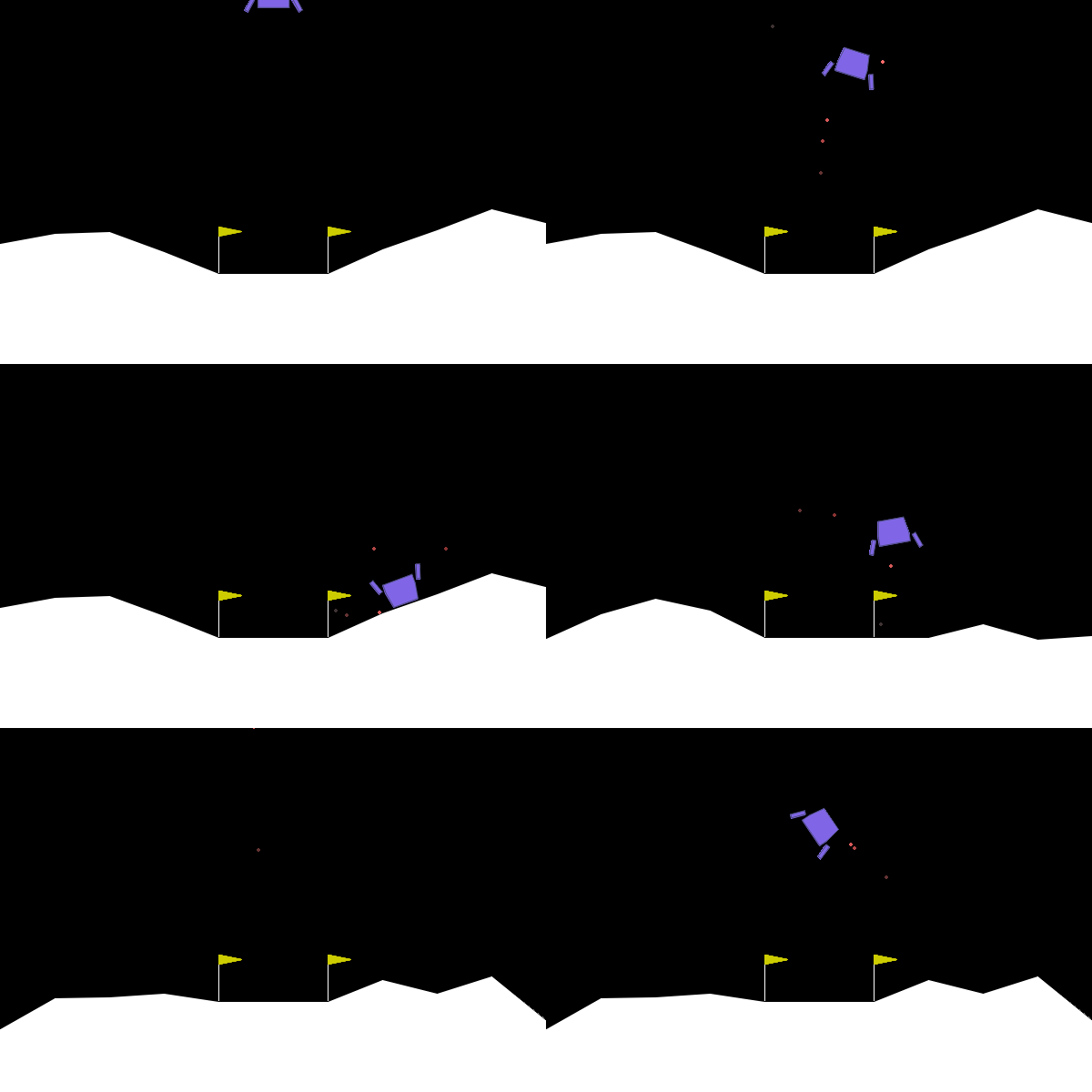
There was a very interesting lab in the course of Unsupervised Learning, Recommenders, Reinforcement Learning taught by Prof. Andrew Ng, which trains a machine learning model to make sure the lunar lander land in a pre-defined range of area. In the course, Andrew also mentioned one of his team's great work that using machine learning model to drive a toy helicopter flying inverted in the real word. That's amazing, the work they have done has been published: Autonomous Helicopter Aerobatics through Apprenticeship Learning.
The entire lab is based on the Gymnasium, which provides experiential environments for reinforcement learning. After finished the lab, I noticed the Gymnasium is quite flexible and easy to extend, making it possible to play the env in some fancy ways beyond the default configuration.
自各类计算机程序开始被编写、运行开始,我们就一直想通过各种方式来了解它的执行过程和状态从而判断计算机程序运行的行为和效率。作为被使用最广泛的操作系统,Linux 经过多年发展,拥有了各类工具和组件来实现对用户程序以及内核程序的追踪,这些组件组成了 Linux 的追踪(Tracing)系统,它的魔力令人着迷。
本文将从最基础也是最灵活的 Kprobes(Kernel Probes) 入手,了解 Linux Tracing 系统的设计(本文基于 linux kernel v6.15.4)。

Based on disk and file management, now we are able to store the user space program on the disk, and let them run after kernel started. But before that, there is still a topic we haven't covered: how does xv6 jump from kernel space to user space?
After all, the content we talked about in previous chapters is only limited in the supervisor level, even machine level, where the code has full control of hardware. However, the user space program cannot be granted such huge scope of control, then we should know how to jump from kernel space to user space, so that we could provide a safer environment for the user program.
In this chapter, we are going to find it out.

With all of the content in the previous chapters, we have known how to initialize and run a process, but before the kernel runs the first line of a process's code, a question still remained, how does my user program store in the disk and how is it loaded?
In this chapter, we are going to discover the disk management and file system in the xv6, we'll see the persistence stack from the top to the bottom, let's get started!

In this chapter, we are going to explore the cpu virtualization, also known as process, in the xv6.
I'm really excited about writing this chapter, because process is one of the fundamental concepts of the operating system. Process is very useful for multiple tasks, and in the design wise, its abstraction is also very elegant.

We have learnt how to setup risc-v in rust, and also initialized risc-v to be able to print format strings, in this chapter we are taking the first look of the OS kernel, and will try to figure out the memory management in xv6.

With the help of the previous article, right now we have a good foundation for running rust on risc-v platform.
In the second episode, we are going to jump into some real code of
xv6, and take care of the initialize from machine level to supervisor
level, and finally, make the printf!() macro available in
our code!

Xv6 is one of the best operating systems for teaching. It’s a great way to learn about how an OS works with basic functions and few lines of code.
Originally, xv6 was written in C, which is awesome for students to get hands-on experience with such a classic programming language. But now that Rust is gaining traction—especially since rust-for-linux is becoming a part of the main line Linux—wouldn’t it be fun to run xv6 using Rust?
As a perfect way to kill time, I have migrated most of xv6 from C to Rust. You can check it out here. During this migration process, I encountered many sorts of issues and tricky stuff, nothing brings me more satisfaction than successfully resolving a problem!
Therefore, I believe it would be cool for me to share my experiences through a series of articles detailing how I did this, complete with a more structured approach and clear procedures.
All right, let's get started...